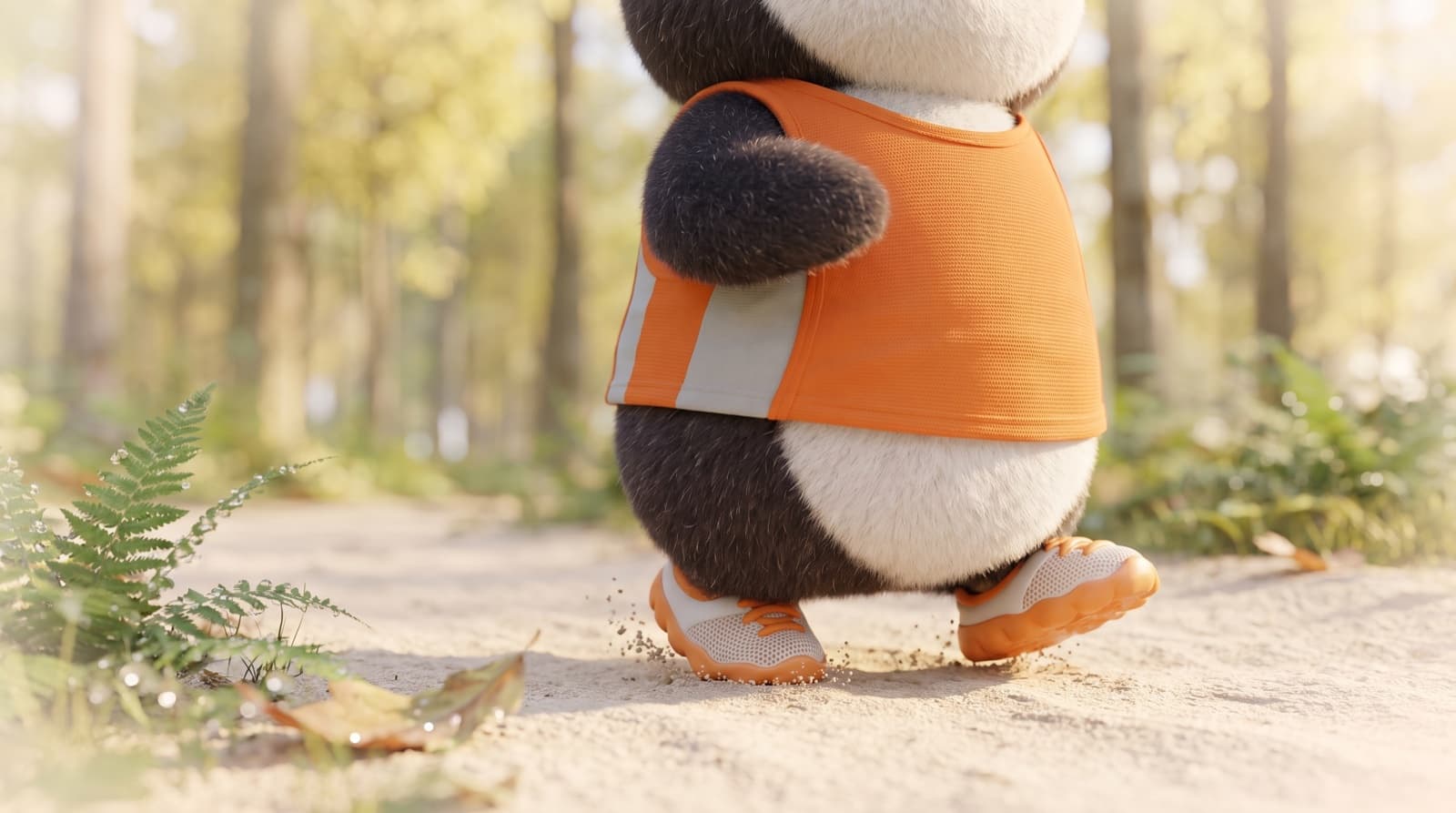
Heel, Midfoot or Forefoot? How Your Foot Should Land When You Start Running
Most runners land on their heel, and switching to your toes won't make you safer. What the research says about foot strike, the one form change that helps, and how to pick first running shoes.
By Just5K
Key Takeaways
- Most runners land on their heel. In a study of 936 road race runners, nearly nine in ten did. Even among elite half marathoners, three in four did.
- Switching to your toes doesn't make you safer. A 2020 review of 53 studies found no good evidence that it prevents injuries, and found it moves the work to your calves and ankles.
- One change does help: shorter, quicker steps that land closer to under your body. Don't reach forward with your foot.
- For shoes, comfort beats technology. In large trials, matching shoes to your arch or "pronation" didn't reduce injuries.
The Short Answer
Let your foot land the way it lands. For most people that's the heel, and that's fine.
What matters more than which part of your foot touches first is where it touches: close to under your body, not stretched out in front of you. That's the whole lesson. The rest of this article is why.
What Most Runners Actually Do
If you've read that "real runners" land on the front of the foot, the numbers say otherwise.
- In a 2011 study that filmed 936 mostly recreational runners at the 10 km mark of a road race, 89% landed on their heel, 3% on the middle of the foot and 2% on the front. The rest landed differently on each foot. How they landed had nothing to do with how fast they finished.
- At a city marathon, another study classified 1,991 runners: 94% landed on their heel.
- Even at an elite half marathon, 75% of runners landed on their heel, including 62% of the 50 fastest.
So if your heel touches first, you're in the large majority, alongside plenty of fast people.
Why Switching to Your Toes Isn't the Answer
The idea that landing on the forefoot is more "natural" and safer got popular during the barefoot running boom. The research hasn't backed it up.
A 2020 systematic review pulled together 53 studies on foot strike. The only evidence that landing on the front of the foot means fewer injuries came from studies that looked back at past injuries, which can't show cause and effect. Switching didn't make running more efficient either. What it did do was move the load: less on the knee, more on the ankle and calf. The authors concluded that a runner without an injury shouldn't change how their foot lands. An earlier review came to the same view.
For a beginner, that shift matters. Your calves and Achilles tendons aren't used to running yet. Asking them to do extra work on every step is the last thing they need in week 1.
The One Change That Helps: Shorter, Quicker Steps
The thing worth fixing is overstriding: reaching your foot far out in front of you and landing on a straight leg. Each step works a little like a brake.
In a 2011 lab study, 45 recreational runners ran on a treadmill at their usual speed, first with their normal steps, then with more steps per minute. Taking 5% more steps cut the work the knee had to absorb by about a fifth; 10% more steps cut it by about a third. With quicker steps, the foot landed closer to under the body and the braking force dropped. One caveat: the study measured load in the lab, not injuries over months.
How to use this:
- Think "quick, light feet", not "long strides". Let each foot land close to under your hips.
- Don't chase a number. You may have heard that everyone should take 180 steps a minute. There's no good evidence for that target; the runners in the study above naturally took about 173. If you try anything, it's a few more steps a minute, not a new rhythm.
- Keep it slow. At a gentle pace with short steps, most of this sorts itself out. Slow is exactly right for now, and walk breaks are part of the method.
Tip: On your next run interval, count your steps for 30 seconds at your usual easy pace. Then try fitting in a couple more in the same 30 seconds, without speeding up. That's what shorter steps feel like.
Do You Need a Special Shoe for Your Foot?
Some shops watch you walk or look at your arches, then suggest a "stability" or "motion control" shoe if your feet roll inward (that rolling is called pronation). The big studies don't support it.
- 927 new runners, one shoe. A Danish study gave 927 beginners the same neutral shoe and followed them for a year. Foot type made no significant difference to injuries. The runners whose feet rolled inward actually had slightly fewer.
- More than 7,000 recruits. US Army, Air Force and Marine trials gave some recruits shoes matched to their arch shape and others a standard shoe. Injury rates were the same.
- Cushioning. In a trial of 848 runners, a softer version of the same shoe meant fewer injuries, though mainly for lighter runners. You don't need the thickest foam on the shelf, but a normal cushioned running shoe is a sensible pick.
- Heel-to-toe drop. In a trial of 553 runners, the height difference between heel and toe made no difference to injury risk overall.
- Barefoot-style shoes. In a small study, 10 of 19 experienced runners who moved gradually to barefoot-style shoes over 10 weeks showed early signs of bone stress in the foot on scans. Not a shoe for your first months.
Researchers have proposed a simple rule instead: pick the shoe that feels most comfortable to you. It's an idea rather than a proven result, but it fits everything above.
How to Choose Your First Running Shoes
- You don't need an expensive pair. The NHS says pricier shoes may last longer or weigh less, which matters for long-distance runners, and that cheaper models are fine for beginners.
- Try several pairs and take the one that feels like nothing when you walk and jog a few steps in the shop.
- Leave about a thumb's width between your longest toe and the end of the shoe. For many people that's half a size up from their everyday shoes.
- Try them on later in the day, when your feet are a little bigger, and in the socks you'll run in.
- Ignore arch-type labels. Comfort is the better guide.
How long do they last? You'll often see 300 to 500 miles. It's a rule of thumb rather than something tied to injuries, and a beginner's walk-run plan covers far less than that. Your first pair will see you through your first 5K with plenty to spare. There's a fuller guide in running shoes for beginners.
If you haven't bought running shoes yet, don't let that stop you. For your first few walk-run sessions, any comfortable sneakers will do.
When It's Pain, Not Form
Normal muscle soreness fades within a day or two. Pain that's sharp, gets worse as you run, or sits in one spot on a bone is different, and no change of stride or shoe is the fix. Stop, rest, and if it doesn't settle, see a doctor or a physio. If it's your shins, read shin splints when you start running. There's more on easing off in Couch to 5K too hard?
Where Just5K Fits
Full disclosure: this is our app. Just5K doesn't analyse your stride or sell you shoes. It does the thing that helps most: it keeps you slow. Your first sessions are one-minute jogs between walks, the run player keeps pace small on the screen so you don't chase speed, and a voice tells you when to run and when to walk.
It's in a free public beta on TestFlight now, and after the App Store release the whole road to your first 5K stays free.
FAQ
Is it bad to land on your heel when running?
No. Most runners land on their heel, including many fast ones. What adds braking is landing with your foot far out in front of you, whichever part of it touches first.
Should beginners run on their toes?
There's no need. Switching to the front of the foot hasn't been shown to prevent injuries, and it puts more work on your calves and Achilles tendons, which are new to running.
What is overstriding?
Reaching your foot far out in front of your body and landing on a straight leg. Shorter, quicker steps fix it, and they come naturally when you run slowly.
Do I need running shoes for Couch to 5K?
For the first sessions, any comfortable sneakers are fine. If you keep going, a comfortable pair of running shoes is worth it. It doesn't need to be an expensive one.
Should I get a gait analysis at a running shop?
It can be a good way to try on lots of shoes. But in large trials, matching shoes to foot type didn't reduce injuries, so pick the pair that feels best, not the one your arch "needs".
Your feet already know what to do. Keep the pace easy and the steps short, wear shoes that feel good, and let the walk-run plan do the rest.