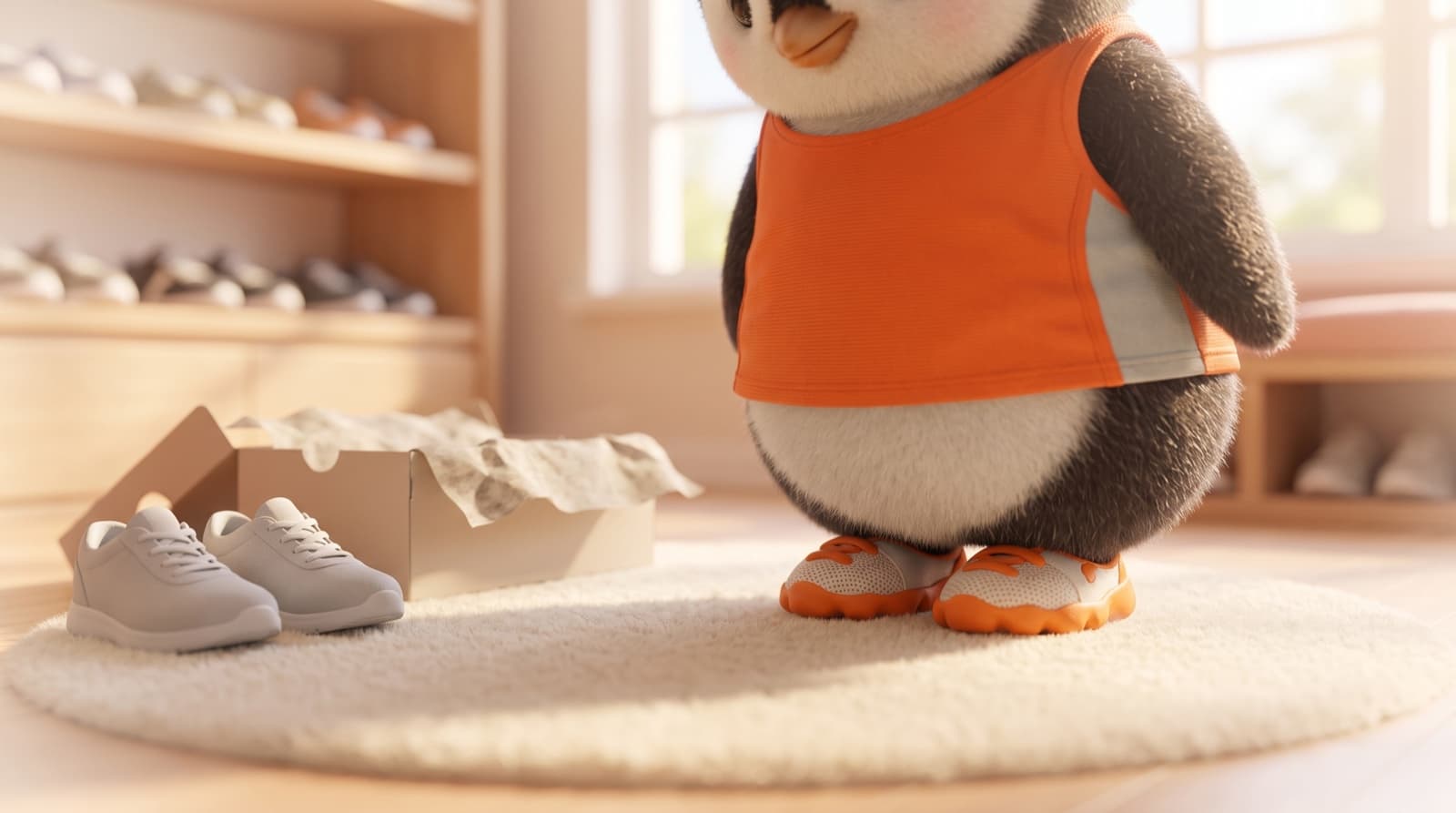
Running Shoes for Beginners: How to Choose Your First Pair
You don't need the shoe with the most foam, a gait analysis or a big budget. What the research says about running shoes, how a pair should fit, and when it's worth buying one.
By Just5K
Key Takeaways
- For your first weeks of walk-run, any comfortable sneakers will do. No study has compared running shoes with ordinary ones.
- When you buy a pair, choose by comfort and fit. Matching shoes to your arch or "pronation" probably makes no difference to injuries.
- A normal cushioned running shoe is a sensible first pick. Skip barefoot-style and carbon-plate shoes for now, and don't pay extra for the most foam.
- It doesn't need to be expensive. Cheaper models from running brands are fine for beginners.
- Fit matters more than the brand: about a thumb's width at the toes, tried on later in the day, in the socks you'll run in.
Do You Need Running Shoes to Start?
Not on day one. A Cochrane review of running shoe trials found that no study has ever compared running shoes with ordinary shoes, so nobody can say you're at risk without them. The early sessions of a Couch to 5K plan are short: a few minutes of jogging spread over half an hour of mostly walking. For walking, the NHS says any comfortable, supportive shoes that don't give you blisters will do.
Once you're out three times a week and planning to keep going, a pair of running shoes is worth buying. The American Academy of Orthopaedic Surgeons suggests a sport-specific shoe once you do one activity more than twice a week. Until then, don't let "I haven't got the right shoes" be the reason you don't start. The same goes for watches and the rest of the kit: it's easy to overcomplicate your first 5K.
What the Research Says About Running Shoes
The big picture first: in the Cochrane review of 12 trials and more than 11,000 people, no type of running shoe has been shown to prevent injuries. Here's how the popular claims hold up.
| What you'll hear | What the research found |
|---|---|
| "Match the shoe to your arch" | Three military trials with more than 7,000 recruits: shoes chosen by foot shape probably make no difference (moderate certainty). |
| "Flat feet need motion-control shoes" | Mixed. In 927 Danish beginners all in the same neutral shoe, feet that rolled inward weren't hurt more. One trial found motion-control shoes helped runners with flatter feet; another found they caused the most pain. |
| "More cushioning is safer" | In 848 runners, a softer version of the same shoe meant fewer injuries for lighter runners, but made no clear difference for heavier ones. An earlier trial found no difference at all. |
| "Expensive shoes protect better" | In a lab study, cheap and mid-priced shoes cushioned as well as or better than expensive ones, and comfort had nothing to do with price. |
| "Barefoot shoes are more natural" | No fewer injuries in trials, and in one more. Risk rose for runners above about 71 kg. |
| "Low-drop shoes are better" | One trial: no difference overall, and the effect flipped depending on running experience. Not a rule. |
One honest note: several of these trials were run with researchers from Decathlon, using prototype shoes. That doesn't make them wrong, but it's worth knowing.
Choose by Comfort
With no shoe type proven to prevent injuries, researchers have proposed a simpler rule: pick the shoe that feels most comfortable to you. It's an idea, not a proven result, but newer data points the same way. In a follow-up of the 848-runner trial, runners who liked their shoes most got injured less often.
Comfort can be swayed, though. In one small study, women rated an identical shoe as more comfortable when it was labelled "gait-matched". So judge the shoe on your feet, not the story on the box.
What about a gait analysis?
Many running shops film you on a treadmill and suggest a shoe for your "gait". No trial has shown that this prevents injuries, and the trials of matching shoes to foot type found no benefit. It's still a good way to try lots of pairs with help. Just pick the one that feels best, not the one your arch is supposed to need.
How Running Shoes Should Fit
- Shop later in the day. Feet can swell by up to about 8% over the course of a day.
- Wear the socks you'll run in, and try both shoes on, laced.
- Leave about a thumb's width (1 to 1.5 cm) between your longest toe and the end of the shoe. For many people that's half a size up from their everyday shoes, but sizes vary between brands, so go by fit, not the number.
- Fit the bigger foot. Most people's feet differ slightly in size.
- Your heel should stay put when you walk, without slipping up and down.
- Too narrow? Look for a wider model rather than a bigger size.
- No breaking in. If it pinches in the shop, it'll pinch on a run. The orthopaedic surgeons advise against shoes that need stretching.
- Walk and jog a few steps in them, on a hard floor if you can.
Women's feet aren't just smaller men's feet: they differ in shape, so if neither the women's nor the men's version of a shoe fits, try a different model.
How Much to Spend
Less than you think. The NHS says pricier shoes may just last longer or weigh less, and every brand makes cheaper models that suit beginners. A mid-priced cushioned shoe that fits well beats an expensive one that doesn't.
Shoes to Skip for Now
- Barefoot or minimalist shoes. In one trial, runners in part-minimalist shoes had three times as many injuries as those in neutral shoes, and a small study found early signs of bone stress in the feet of runners switching to them. If you want to try them one day, much later and very slowly.
- Carbon-plate "super shoes". They're built for racing. There's no evidence they help beginners, and doctors have reported foot bone stress injuries in competitive runners who wore them. At walk-run pace there's nothing to gain.
If You're a Heavier Runner
You don't need the thickest, most expensive shoe. In the cushioning trial, softer shoes protected lighter runners, not heavier ones, so pick a normal cushioned shoe that feels good rather than chasing maximum foam. The one clear warning is about barefoot-style shoes: in one trial, injury risk in them rose above about 71 kg. Some podiatrists also suggest heavier runners replace their shoes a little sooner. There's more in how to start running when you're overweight.
Do You Need Two Pairs?
Not to start. In a study of 264 runners, those who switched between more than one pair got injured less often, but that was an observational study: people who own two pairs may differ in other ways too. It's an option once running is a habit, not a requirement.
When to Replace Running Shoes
The usual advice ranges from 300 to 500 miles (about 480 to 800 km): sports podiatrists say 350 to 500, Mayo Clinic Health System physical therapists say 300 to 400. That's expert guidance, not a trial result: no study has linked a mileage number to injuries. Lab tests do show the foam losing some of its cushioning as the miles add up.
For scale: a whole eight-week Couch to 5K plan, walks included, adds up to roughly 80 to 100 km. One pair will see you through it with plenty to spare. Replace them when the sole is worn through, the foam has deep creases, or they suddenly feel flat and your legs start to ache in ways they didn't before. If it's your shins that ache, new shoes are rarely the whole answer: see shin splints when you start running.
Where Just5K Fits
Full disclosure: this is our app. Just5K doesn't sell shoes and has no shoe partners. The plan starts with one-minute jogs between walks, so your first weeks work in any comfortable sneakers, and the app's Tips tab has the short version of this guide for when you're ready to buy a pair. For how your foot should land once you're in them, see how your foot should land when you run.
Just5K is in a free public beta on TestFlight now, and after the App Store release the whole road to your first 5K stays free.
FAQ
Do I need running shoes for Couch to 5K?
Not for the first weeks. Any comfortable sneakers that aren't falling apart are fine. Once you're running three times a week and plan to keep going, a comfortable pair of running shoes is worth it.
What running shoes should a beginner buy?
A normal cushioned running shoe that feels comfortable as soon as you put it on, with a thumb's width of room at the toes. The brand, the colour and the technology on the box matter much less than the fit.
Should I get a gait analysis?
You don't need one. No trial has shown it prevents injuries. It can still be a helpful way to try several pairs; just pick the one that feels best.
How much should I spend on my first running shoes?
There's no need for a top-of-the-range pair. In a lab study, cheaper shoes cushioned as well as expensive ones, and the NHS says cheaper models are fine for beginners.
Should running shoes be a size bigger?
Often half a size bigger than your everyday shoes, because you need about a thumb's width at the toes and feet swell during the day. Go by the fit, since sizes vary between brands.
How often should I replace running shoes?
The common guidance is every 300 to 500 miles (480 to 800 km), but that's a rule of thumb. Replace them when they're visibly worn or start to feel flat.
What are the best running shoes for overweight beginners?
There's no special category that's proven to be safer. Pick a comfortable cushioned shoe that fits well, and avoid barefoot-style shoes, where injury risk rose for heavier runners in one trial.
The best running shoe is the one you forget you're wearing. Start in what you have, buy a comfortable pair when you're hooked, and spend the rest of your energy on showing up.